Cholesterol has been cast as one of medicine’s great villains. Avoid it. Lower it. Fear it. Billions of dollars in medication have been built on that premise, and millions of people have been managing their diets and taking daily pills based on the belief that less cholesterol means a healthier heart.
But the story is considerably more complicated. The question that actually matters is not how much cholesterol is circulating in your blood, but why it is there, and what conditions put it there.
What Cholesterol Actually Is
Your liver and intestines produce approximately 80% of the cholesterol your body needs. The remaining 20% comes from food. The body manufactures most of its cholesterol itself because it cannot afford to rely on dietary supply alone — cholesterol is that essential.
Here is what your body is doing with it right now:
| Function | What It Means |
|---|---|
| Every cell membrane | Every one of your approximately 37 trillion cells is wrapped in a membrane built partly from cholesterol. It determines how fluid, flexible, and responsive that membrane is. |
| Every steroid hormone | Estrogen, testosterone, progesterone, cortisol, and DHEA are all built directly from cholesterol. |
| Vitamin D | The vitamin D your body produces when sunlight touches your skin begins as cholesterol and supports immune and bone health. |
| Bile acids | The liver converts cholesterol into bile acids, without which dietary fats cannot be digested or absorbed properly. |
| Brain and nerve function | The brain contains roughly 20–25% of your body’s total cholesterol. It is essential for neural communication, memory, and learning. |
Cholesterol is not a toxin the body accidentally produces. It is a raw material the body deliberately manufactures in large quantities because it is essential to virtually every major biological system.
So Why Does It Have Such a Bad Reputation?
The short answer: an incomplete scientific hypothesis in the 1950s became public health policy, and an enormous pharmaceutical industry grew around it. The nuanced research that followed — showing no consistent link between saturated fat intake and cardiovascular mortality — largely never made it to the public conversation.
What did make it was the “lower is better” message, the low-fat era, and the statin prescription.
The Real Story: Inflammation, Not Cholesterol
Picture your arteries as smooth, flexible pipes carrying blood through your body. The problem begins not with cholesterol but with inflammation — when those pipe walls become damaged on the inside.
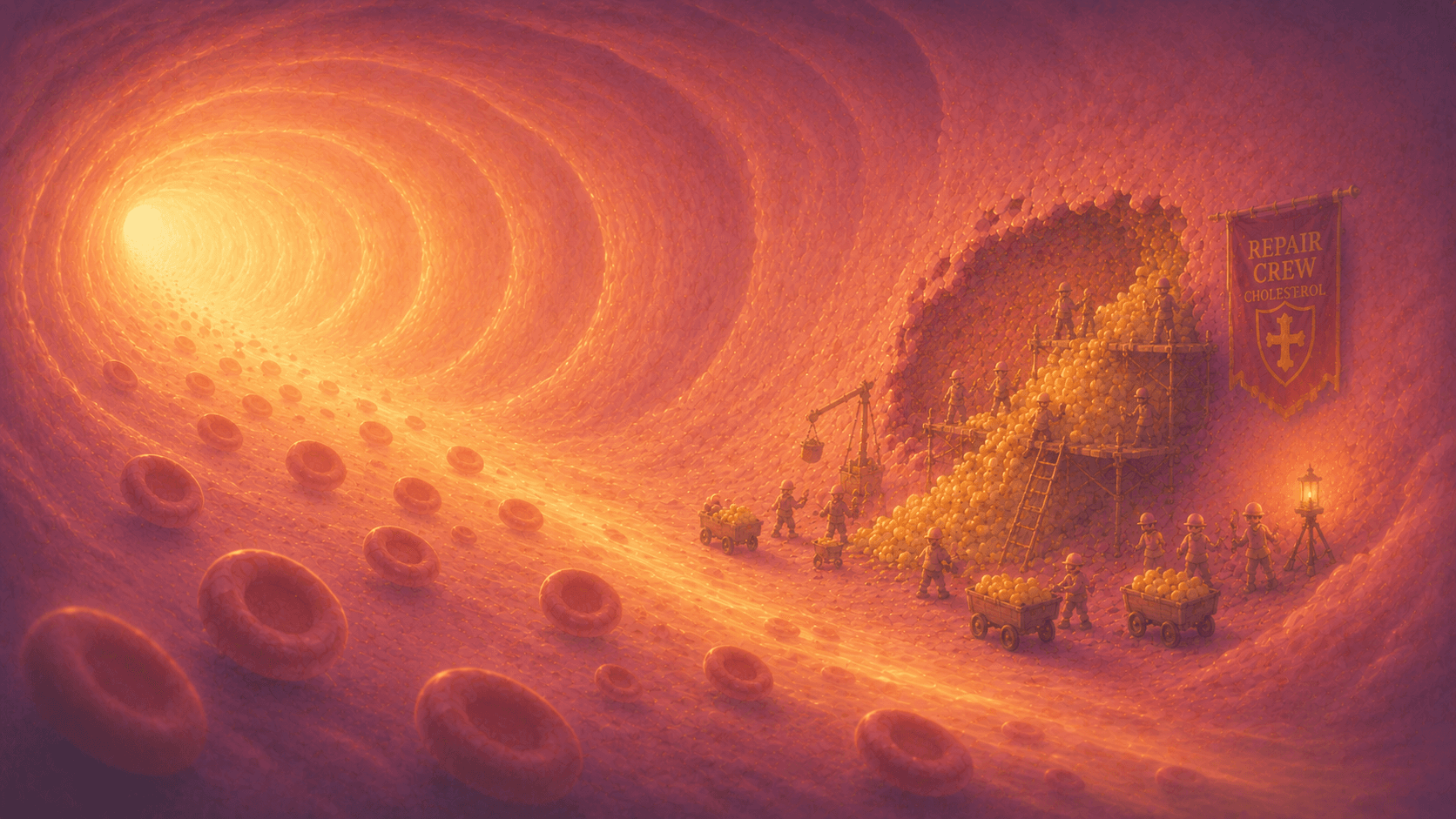
When inflammation damages the arterial wall, cholesterol arrives to repair it — like a construction crew showing up to patch a crumbling wall. But when the damage is chronic, the repair crew never leaves. More materials keep arriving. Over time, that buildup hardens and thickens inside the pipe, slowly narrowing it until blood flow is compromised.
Heart disease does not begin with cholesterol. It begins with inflammation.
What keeps setting the fire
- Chronic inflammation. Sustained inflammatory stress from poor diet, toxins, chronic illness, or gut dysfunction is a major driver of arterial damage.
- Excess refined carbohydrates and sugar. The liver converts surplus glucose into fat, increasing triglycerides and small, dense LDL particles.
- A burdened liver. The liver manages cholesterol traffic. When overwhelmed by toxins, poor diet, or chronic stress, cholesterol handling worsens.
- Chronic stress. Cortisol dysregulation can drive inflammation, disrupt lipid metabolism, and impair liver function.
Should You Worry About Your Cholesterol Number?
For most people, dietary cholesterol has less impact on blood cholesterol than overall dietary pattern, inflammation status, and liver function.
This does not mean elevated LDL carries no cardiovascular risk. It can be meaningful — especially when paired with chronic inflammation, poor metabolic health, and lifestyle imbalance. The key is context.
What Actually Supports Healthy Cholesterol Metabolism
- Reduce refined sugar and processed carbohydrates. Often the highest-impact nutrition lever for improving lipid profiles.
- Eat healthy fats. Avocado, olive oil, nuts, fatty fish, and quality eggs can support HDL and reduce inflammatory load.
- Support the liver. Cruciferous vegetables, hydration, and limiting alcohol help with cholesterol regulation.
- Address inflammation at its root. Gut health, sleep quality, stress regulation, and lowering toxic burden all matter.
- Move your body and prioritize sleep. Both consistently improve cardiovascular risk markers.
The Question Worth Asking
If your doctor has told you your cholesterol is high, take it seriously — but ask for a fuller conversation than a single number and a prescription. What is driving the inflammation? What is your liver doing? What do your triglycerides and LDL particle patterns reveal?
Cholesterol is not your enemy. It is your body’s raw material, its repair crew, and its most faithful reporter of what is happening deeper. The question worth asking is not how to silence the reporter — but what story it is trying to tell.
The Healing Dawn | A Center for Transformative Discovery | thehealingdawn.com