What Is White Noise, Anyway?
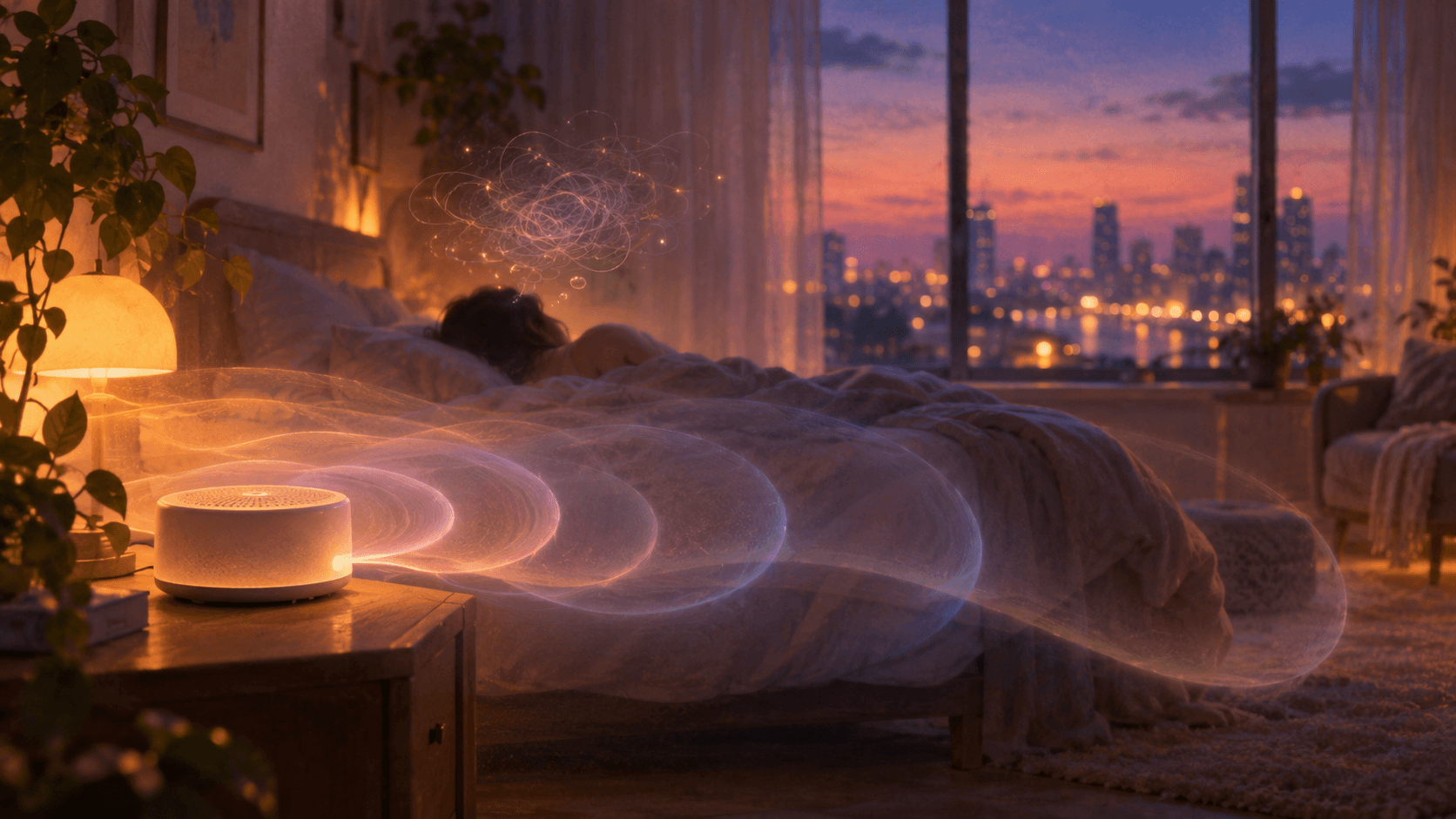
Picture trying to fall asleep while a door slams, a car passes or someone turns on a television. Your brain notices sudden changes in sound—even when you are drowsy. A gentle, steady background sound can partly cover those changes. This is called sound masking. Think of it like a bandage: it covers the problem, but it doesn’t heal it.
The key distinction: masking a disruptive noise is not the same as improving the biology of sleep. If your bedroom is already quiet, adding noise may offer little benefit.
Many machines also offer softer or deeper versions of this sound, sometimes called pink or brown noise. None has been proven best for everyone. What you enjoy listening to and how much outside noise you have matter more than the setting on the machine.
What Does the Latest Research Actually Say?
Some people do sleep better. A recent review of clinical studies found that some groups, including hospital patients, reported better sleep. But the studies varied widely in quality, sound levels, and how sleep was measured. [1]
An important caution about REM sleep. In a recent sleep-lab study, steady pink noise (a softer version of white noise) played through the night actually reduced REM sleep, the dreaming stage linked with memory and emotional processing. Simple foam earplugs protected sleep from outside noise better. It was a small study, so it doesn’t prove every sound machine has the same effect, but it’s worth knowing. [2]
Quieter didn’t always mean better. In a study of older adults in the hospital, white noise smoothed out sudden changes in sound, yet their sleep didn’t measurably improve. [3]
The Practical Guide
How to Use a Sound Machine Wisely
Start with the room. Lower outside noise when possible: close windows, fix rattles, use curtains or consider comfortable earplugs if you can still hear important alarms.
Use the lowest helpful volume. Place the machine across the room, not next to your head. It should blend into the background rather than dominate it.
Try a timer. If the sound helps you fall asleep, try switching it off after 20–45 minutes instead of running it all night.
Test, do not assume. Compare several nights with and without sound. Note how long you take to fall asleep, how often you wake and how refreshed you feel.
Skip the earbuds. Speakers across the room are a better choice than sleeping with earbuds or headphones pressed against your ears.
A Special Note for Babies and Young Children
Sound machines can sometimes soothe infants, but some devices can play too loudly. The American Academy of Pediatrics recommends placing any infant sleep machine as far from the baby as possible, keeping the volume low, and limiting how long it plays. Do not put a sound machine in the crib. The long-term effects of continuous noise on developing sleep are not well established. [4]
First, Rule Out the Physical
A sound machine only covers up sound. If something physical is disrupting your sleep, such as sleep apnea or restless legs, masking noise won’t help. If you snore loudly, gasp during sleep, or feel unusually sleepy during the day, ask about an evaluation so these can be ruled out. And if your body checks out but restful sleep still won’t come, it may be time to look deeper.
The Deeper Layer: The Noise Within
When we cut a finger, a bandage covers the wound, but it isn’t what heals it. Underneath, the body, which knows how to heal itself, quietly does the work.
Sleep problems are different. They often have deeper roots, and a bandage of sound can’t reach them. When the body lacks the conditions it needs, it struggles to keep us balanced and healthy, and sleep is often the first thing to suffer.
That’s because nothing in us works alone. Think of a plant: to grow and bloom, it needs countless nutrients in the soil, the right amount of water, and the right amount of sun. If even one is missing, the whole plant struggles. Our sleep works the same way. It is connected to what we eat, how we move, the stress we carry, and what is happening in our inner world.
For many people, the hardest noise at night doesn’t come from the street. It comes from within. The moment the room goes quiet, the mind gets louder: replaying the day, worrying about tomorrow, arguing with itself.
That inner noise keeps the body on alert. Stress tells the body it is in danger, so it stays in survival mode: muscles tense, heart racing, ready to react. Deep, restorative sleep comes only when the body gets the message that it is safe enough to switch off survival mode and shift into rest-and-repair.
A sound machine may drown out that inner chatter for a while. But like a bandage, it can only cover what’s there.
In our work with patients, we have found that what can truly drown out the inner noise is not a louder sound but the quiet voice of our spirit. Sleep is the time when the intellect is meant to step aside so that the spirit, our true essence, can become active. Learning to hear that voice often takes work. But as it grows clearer, we find we need far less distracting noise outside.
Research Behind This Article
[1] Ding et al., Sleep Medicine (2025), systematic review/meta-analysis. PubMed
[2] Basner et al., SLEEP (2026), pink noise and REM sleep. PubMed
[3] Jaiswal et al., HERD (October 8, 2026), hospitalized adults. doi:10.1177/19375867261484093
[4] American Academy of Pediatrics, noise exposure guidance (2023). AAP guidance