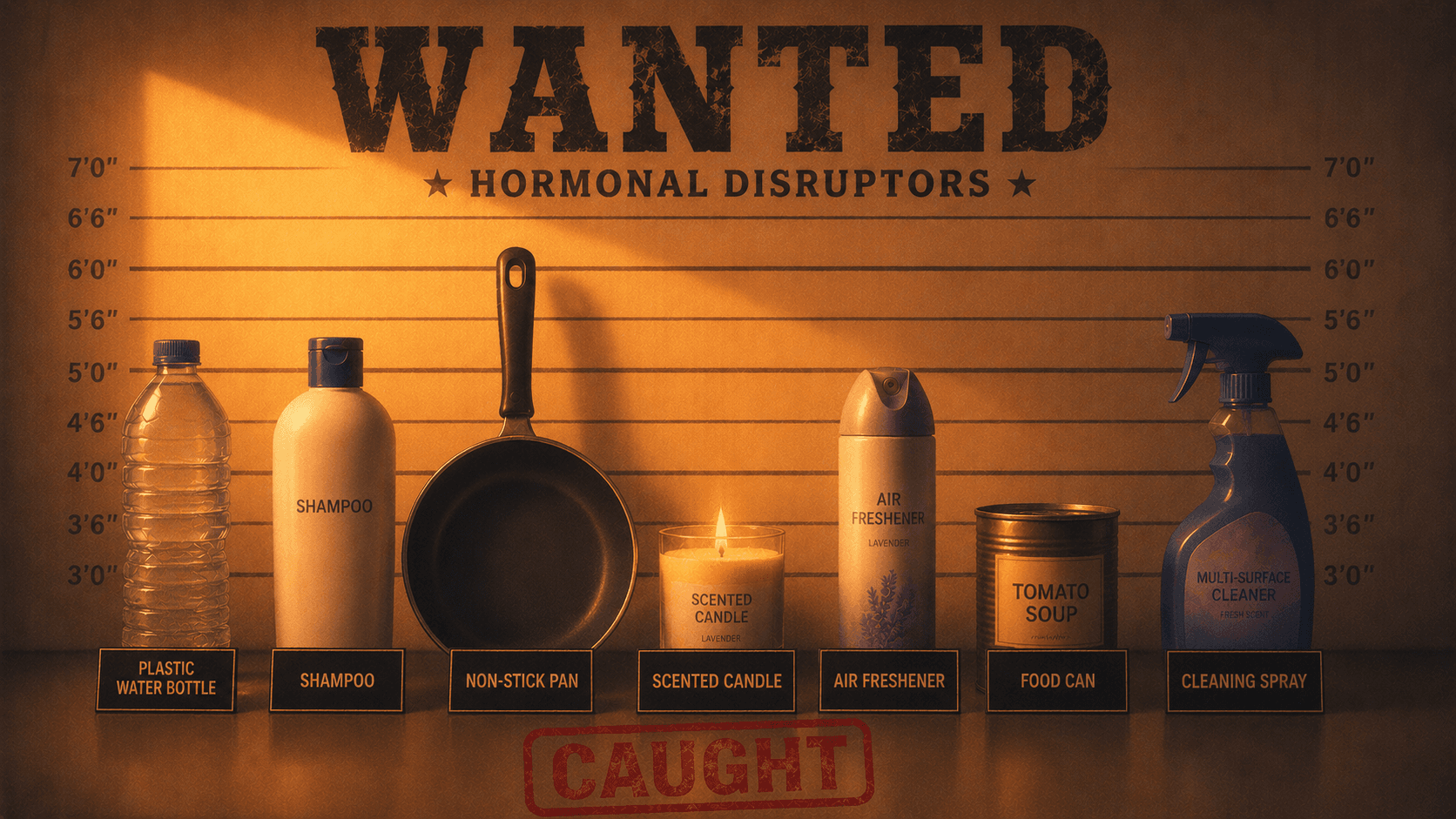
There is a category of chemical that does not need to be toxic in the conventional sense to cause harm. It does not need to poison you acutely or trigger an immediate reaction. It simply needs to send the wrong signal, at the wrong time, in the wrong amount to the system that governs nearly every function in your body.
That system is the endocrine system. The signals are hormones. And the chemicals that interfere with them are called endocrine-disrupting chemicals, or EDCs.
A 2024 report from the world's leading scientific and medical experts on hormone-related health conditions raises new concerns about the profound threats to human health from EDCs, with increasing evidence that this group of toxic substances may be implicated in rising global health concerns including infertility, diabetes, immune deficiencies, and other serious conditions. What makes this particularly significant is not just the severity of the effects, but where these chemicals are found. They are not confined to industrial sites or specialized environments. They are found in cleaning products, food packaging, drinking water, carpets, children's toys, and many other everyday items.
They are, in all likelihood, in your home right now.
How EDCs Work — and Why the Body Cannot Simply Ignore Them
To understand why EDCs are a problem, it helps to understand how hormones work.
Hormones are the body's chemical messaging system. They are produced in tiny amounts by the endocrine glands, travel through the bloodstream, and attach to specific receptors on target cells — like a key fitting a lock. When the right hormone fits the right receptor, the cell receives its instruction: grow, divide, slow down, produce this enzyme, release that protein.
EDCs interfere with this system in several ways. Some mimic hormones closely enough that they fit the receptor and trigger a response the body never intended. Others block receptors, preventing the body's own hormones from binding. Others disrupt the production, transport, or breakdown of hormones — quietly altering levels without the body being able to correct the imbalance.
The body's hormonal system was calibrated over thousands of years of evolution. It was not designed to handle tens of thousands of synthetic chemicals, many of which did not exist until the last century.
Where They Hide — The Most Common Sources
The challenge with EDCs is not that they are difficult to find, but that they are ordinary, quietly woven into the fabric of daily life in ways most people have never realized.
Plastics. This is the most pervasive source. Bisphenol A (BPA) and its relatives are found in hard plastic containers, the lining of food and drink cans, and plastic water bottles. Phthalates, a family of chemicals used to make plastic flexible, are found in food wrap, plastic bags, and soft plastic containers. Evidence also suggests that high levels of phthalates can be found in fatty meats and cream-based dairy products, likely because these foods are exposed to plastic during production and delivery. Plastic heated in a microwave or dishwasher releases significantly more EDCs than the same container at room temperature. Whenever possible, replace plastics with glass, ceramics or stainless steel.
One important note: "BPA free" products may not be significantly safer — they use BPA substitutes that may be equally problematic but carry different names not yet widely recognized. The issue is with the category of chemical, not just one specific compound.
Personal care products. Many of the personal care products available today are a potential source of EDC exposure. Parabens, used as preservatives in shampoos, lotions, moisturizers, and cosmetics, mimic estrogen and are absorbed directly through the skin. Synthetic fragrances, labeled simply as "fragrance" on ingredient lists, frequently contain phthalates. Triclosan, found in some antibacterial soaps and toothpastes, disrupts thyroid hormone signaling.
Studies have shown that simply switching to personal care products free of phthalates and parabens for just a few days measurably reduces the concentration of these chemicals in the body. You can start today: read the labels, or use apps designed to help identify safer products, make one swap at a time, and let your body do the rest.
Food and food packaging. Pesticide residues on non-organic produce are one of the most consistent sources of EDC exposure in the diet. Glyphosate, the active ingredient in widely used herbicides, has been linked to hormonal disruption and is present on many conventionally grown crops. Food stored in or cooked in plastic containers, particularly when heated, transfers EDCs directly into the food. Canned foods are a particular concern due to the epoxy linings of many cans.
Household products. Your home may be one of the most significant sources of EDC exposure, and one of the easiest to address. Flame retardants are found in furniture, mattresses, and carpets. PFAS — known as "forever chemicals" because they do not break down — are found in non-stick cookware, water-resistant clothing, and stain-resistant fabrics. Synthetic cleaning products, air fresheners, and scented candles release chemical compounds into the air you breathe every day. Natural alternatives exist for almost all of these: cast iron or stainless steel cookware, unscented or naturally scented products, and simple cleaning solutions like vinegar and baking soda go a long way.
Water. Filtering tap water is one of the most straightforward steps you can take. Quality filters — reverse osmosis or activated carbon — remove a broad spectrum of EDCs that water treatment systems do not. Pharmaceutical compounds, agricultural runoff, and industrial chemicals regularly pass through municipal treatment and into the water supply.
What EDC Exposure Does to the Body
The effects of EDC exposure are not always obvious or immediate. They are often cumulative, slow-moving, and easy to attribute to other causes, which is precisely what makes them so insidious.
In women, excess estrogen-mimicking compounds from EDCs can contribute to estrogen dominance — a hormonal imbalance we have explored in other articles — with downstream effects on the menstrual cycle, fertility, thyroid function, mood, and the risk of hormone-sensitive cancers. In men, EDC exposure has been linked to declining testosterone levels and reduced sperm quality. In children, whose endocrine systems are still developing, the consequences can be more severe, including early puberty onset.
Beyond reproductive health, evidence suggests that EDCs contribute to disorders such as diabetes, neurological conditions, chronic inflammation, and compromised immune functioning. These are not rare outcomes. They are among the most common chronic conditions in the modern world.
Reducing Exposure — A Practical Room-by-Room Approach
The goal is awareness and gradual, intentional replacement. Research shows that removing potential sources of exposure measurably lowers chemical concentrations in the body within days. Every reduction contributes to a lower total burden, and the body's ability to clear these compounds, once the ongoing influx is reduced, is remarkable.
Kitchen:
- Replace plastic food storage containers with glass or stainless steel
- Never heat food in plastic — transfer to a glass or ceramic dish
- Filter drinking water with a quality filter — reverse osmosis or activated carbon both remove a broad spectrum of EDCs
- Choose organic produce for the highest-pesticide crops (strawberries, spinach, apples, grapes, bell peppers)
- Avoid canned foods where possible, or choose brands that use BPA-free linings — and be aware that alternatives may carry similar risks
- Replace non-stick cookware with cast iron, stainless steel, or ceramic
Bathroom and personal care:
- Read ingredient labels. Look for and avoid: parabens (methylparaben, propylparaben, butylparaben), phthalates (often hidden under "fragrance"), triclosan, sodium lauryl sulfate, and synthetic musks
- Choose fragrance-free or naturally scented products — "fragrance" on a label is a legal placeholder that may conceal dozens of undisclosed chemicals
- Reduce the total number of products used daily — fewer products means less cumulative exposure
- Choose mineral-based sunscreens over chemical ones, which frequently contain oxybenzone
Home environment:
- Vacuum and ventilate regularly — household dust accumulates EDC-containing particles from furniture, flooring, and electronics
- Open windows when possible to dilute indoor air, which is often more polluted than outdoor air
- Choose natural cleaning products — vinegar, baking soda, and castile soap handle most household cleaning tasks without EDC exposure
- Avoid synthetic air fresheners and scented candles — use essential oils with a diffuser if fragrance is desired
- When replacing furniture or mattresses, look for products certified free of flame retardants
In your food:
- Reduce consumption of conventionally farmed animal products, particularly fatty meats and dairy
- Eat whole, unprocessed foods as much as possible — processing and packaging are the two primary routes of dietary EDC exposure
A Note on the Accumulation Effect
One of the most important things to understand about EDCs is that the risk is not from any single exposure but from the cumulative load. No single shampoo will disrupt your hormones. No single plastic bottle will tip the balance. But twelve personal care products, plastic-wrapped food, a non-stick pan, tap water, and conventionally farmed meat — every day, year after year — creates a sustained hormonal burden that the body was not designed to carry.
The same principle works in reverse. Each replacement, each reduction, each more careful choice contributes to a lower total burden. You do not need to do everything at once. Start with the kitchen as it is where exposure is often highest and where alternatives are most readily available. Then move to personal care. Then the broader home environment. Over weeks and months, the cumulative effect of these choices adds up.
The Deeper Context
EDCs are a product of the same industrial worldview that has progressively separated humanity from the natural world: substituting synthetic for natural, convenient for considered, profitable for healthy. They are one expression of a broader pattern — the consequences of living at increasing distance from the laws of nature and from the wisdom of how the body was designed to function.
The body was created with an extraordinary capacity to regulate, repair, and maintain itself. That capacity requires, above all else, that we do not continuously undermine it. Reducing EDC exposure is an act of respect for the body, which is the vessel of the spirit, and for the Creator who made it.
This article is for educational purposes and does not constitute medical advice. If you are experiencing persistent or concerning symptoms, please consult a qualified healthcare provider.