
Your liver is one of the most hardworking organs in your body. Every day, quietly and without acknowledgment, it processes an extraordinary volume of material: hormones the body has finished using, environmental toxins, metabolic byproducts, dietary chemicals — and renders them harmless. It does this through a sophisticated two-phase process, and in the second phase it attaches a molecule called glucuronic acid to these substances, effectively tagging them for removal. The tagged compound becomes water-soluble, biologically inactive, and ready to leave the body through bile and stool.
The liver has done its job. The threat has been neutralized. Or so it seems.
The Enzyme That Undoes the Work
In a healthy gut, what happens next is straightforward: the tagged compounds travel through the intestine and are eliminated. But in a gut where the microbial balance has been disrupted, a condition known as dysbiosis, certain bacteria produce high levels of an enzyme called beta-glucuronidase.
This enzyme does something that sounds almost unbelievable: it removes the tag.
Think of it this way. A criminal has been caught, tried, and sentenced. The legal system did its job. The threat has been processed, and the paperwork is in order. But before the sentence is carried out, a corrupt actor intercepts the documents, alters the verdict, and releases the criminal back onto the street to offend again. The arrest and the conviction were real, but the outcome was sabotaged by someone operating inside the system.
This is precisely what beta-glucuronidase does. It cleaves the glucuronic acid molecule that the liver worked to attach, reactivating compounds that had already been neutralized. Hormones, toxins, carcinogens, and xenobiotics that were on their way out of the body are freed, reabsorbed through the intestinal wall, and re-enter circulation as if the liver had never touched them. This process is called enterohepatic recirculation, and it forces the liver to process the same substances again and again in a potentially exhausting loop.
Research has now confirmed that gut microbial beta-glucuronidase enzymes can reactivate two distinct estrogen compounds, returning them to their biologically active forms, which can then be reabsorbed into the bloodstream and undergo repeated rounds of recirculation.
The body's own detox system is being quietly sabotaged from within.
What Gets Recycled — and Why It Matters
When beta-glucuronidase is overactive, the consequences ripple through three areas, each one building on the last.
First: the body is forced into an exhausting loop it cannot escape. The liver is a remarkably capable organ, but it was not designed to process the same substances indefinitely. When neutralized compounds are reactivated and reabsorbed, the liver must begin the detoxification process again and again. Over time, this depletes its resources. Antioxidant reserves fall. Inflammatory markers rise. The body's capacity to protect and repair itself is quietly eroded. This is the most universal consequence, and it affects everyone with elevated beta-glucuronidase activity regardless of their specific health situation.
Second: toxins and carcinogens that should have left the body are given a second chance to cause harm. When environmental chemicals, dietary toxins, and other carcinogens are freed from their neutralized state inside the intestine, they come into direct contact with the gut wall before being reabsorbed. Repeated exposure to these reactivated compounds creates chronic irritation, persistent inflammation, and over time the kind of DNA damage associated with colon cancer and rectal cancer. The gut lining, which was never meant to be a repeated point of toxic contact, bears the cost.
Third: for women especially, estrogen levels may be pushed significantly higher than the body intends. The body produces exactly the amount of estrogen it needs, uses it, and then sends the excess to the liver to be neutralized and removed. That process is the body's own judgment about how much estrogen is appropriate. When beta-glucuronidase reverses that elimination, it overrides the body's decision — reintroducing estrogen that has already been marked as finished and unwanted.
The problem is not estrogen itself. Estrogen is essential. The problem is the persistent excess — estrogen circulating beyond what the body chose to keep. Over time, this elevated exposure stimulates cells to divide more frequently than they otherwise would, particularly in estrogen-sensitive tissues such as the breast, uterus, and ovaries. The more frequently cells divide, the greater the opportunity for the kind of errors in that process that, over time, can lead to cancer.
What Drives Beta-Glucuronidase Too High
Elevated beta-glucuronidase activity is not an isolated problem. It is almost always the expression of a gut environment that has been compromised — and the contributing factors are recognizable and common:
- An imbalanced gut microbiome — think of the gut as a garden. When tended well, vegetables and a few weeds coexist without problem. But when the garden is neglected, the weeds overtake it. In the same way, certain bacteria that produce beta-glucuronidase are always present in the gut, and in a healthy balanced gut, they do no harm. It is when they overgrow and crowd out the beneficial bacteria that their enzyme activity rises to levels that begin to undo the liver's work.
- A low-fiber diet — fiber feeds the beneficial bacteria that keep the gut in balance. Without it, the wrong populations flourish and the garden tips toward weeds.
- Constipation and slow digestion — the longer reactivated compounds sit in the intestine, the more time they have to be reabsorbed and cause damage. Regular, complete elimination is not a minor detail, but an important part of the detox process itself.
- High toxin exposure — heavy metals, pesticides, plastics, and environmental chemicals overwhelm the liver's capacity to keep up with its tagging work, increasing the volume of compounds available for beta-glucuronidase to reactivate.
- Poor liver function — if the liver is already struggling, the original neutralization process is impaired even before beta-glucuronidase enters the picture. A burdened liver and an imbalanced gut are a compounding combination.
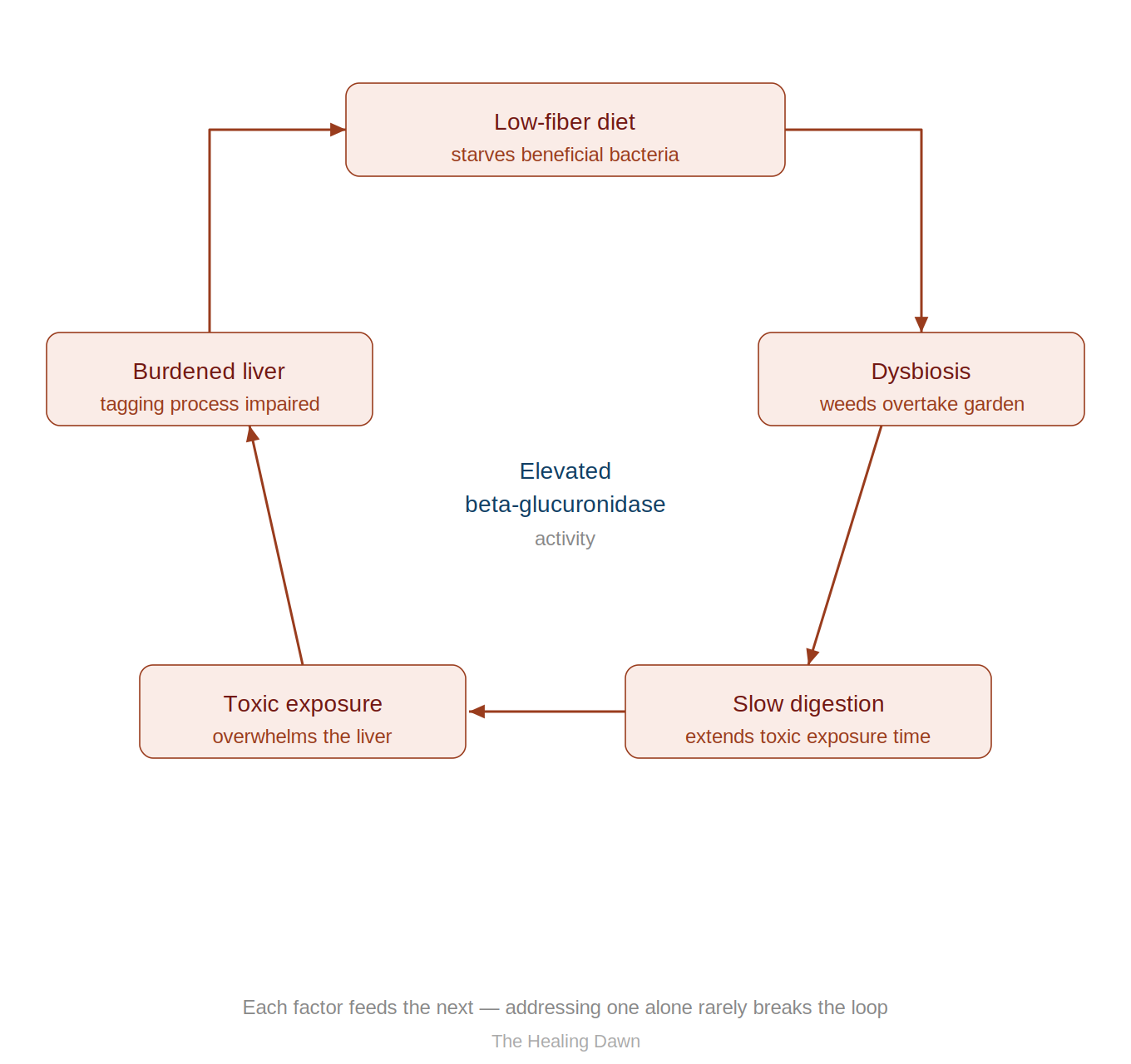
Each of these factors reinforces the others. A low-fiber diet leads to dysbiosis; dysbiosis slows digestion; slow digestion increases toxic exposure; increased toxic exposure burdens the liver. This is why addressing one factor in isolation rarely resolves the underlying loop — and why a whole-body approach is necessary.
Breaking the Loop — What Actually Works
The goal is not to eliminate beta-glucuronidase entirely — in normal amounts it plays a legitimate role in the gut. The goal is to restore the balance in which it does not dominate, and in which the body's elimination pathways are strong enough to complete what the liver began.
Fiber, consistently. Dietary fiber plays a dual role in the garden: it clears the ground by physically binding to toxins and hormones and carrying them toward elimination before beta-glucuronidase can reactivate them, and it fertilizes the beneficial bacteria that keep the gut in healthy balance. Good sources of fiber include vegetables, legumes, flaxseeds, and whole foods — and they should be a consistent part of every day, not an occasional addition.
Ensuring regular, complete elimination. Every additional hour that reactivated compounds spend in the intestine is another hour of exposure to the gut wall. Regular bowel movements are not a minor comfort issue — they are a core part of the detox process. Adequate water, fiber, daily movement, and magnesium all support the body's ability to eliminate completely and on time.
Calcium D-glucarate. This naturally occurring compound — found in apples, oranges, broccoli, and Brussels sprouts, and available as a supplement — works by directly protecting the liver's detoxification tag from being removed. Think of it as a lock on the paperwork: it keeps the sentence in place so the criminal cannot be released. It supports the body's ability to complete the elimination process the liver began, rather than having that work undone in the gut.
Supporting the liver. The liver needs specific nutrients to do its tagging work effectively. Cruciferous vegetables — broccoli, Brussels sprouts, cauliflower, and kale — are among the most powerful foods for supporting the liver's ability to neutralize and prepare substances for elimination. Adequate protein from quality sources gives the liver the raw material it needs. And reducing alcohol, processed foods, and unnecessary medications removes unnecessary burden from a system that is already working hard.
Restoring the gut microbiome. Rebalancing the gut is more than simply taking a probiotic supplement. A healthy gut microbiome depends on three interconnected elements working together.
Prebiotics are the food that beneficial bacteria need to survive and thrive. Without them, probiotics have nothing to live on and their effect is limited and often temporary. Good prebiotic sources include garlic, onions, leeks, asparagus, and green bananas, as well as the fiber-rich foods already discussed.
Probiotics are the beneficial bacteria themselves, introduced through fermented foods such as yogurt, kefir, sauerkraut, and kimchi, or through supplements. Strains from the Lactobacillus and Bifidobacterium families are among the most studied for gut balance and microbiome restoration.
Postbiotics are what beneficial bacteria produce when they digest prebiotics — particularly short-chain fatty acids like butyrate. These compounds directly nourish the gut lining, reduce inflammation, and help regulate the gut environment. They are the downstream reward of having a well-fed, well-populated microbiome.
Taking a probiotic without also providing the prebiotics it needs is a bit like planting seeds in soil with no water or nutrients — the seeds may not survive long enough to make a difference. True microbiome restoration addresses all three layers.
Equally important is removing what feeds the imbalance in the first place: sugar, processed foods, and unnecessary antibiotic use create the conditions in which harmful bacteria overgrow and beta-glucuronidase activity rises.
A note on supplementation. While food is always the foundation, targeted supplementation can play an important supporting role — particularly when the gut has been significantly disrupted or when dietary changes alone are not sufficient. Fiber supplements such as psyllium husk or acacia fiber can help reach the levels the gut needs consistently. Prebiotic, probiotic, and postbiotic supplements are available individually and in combined formulas. As with all supplementation, the right approach depends on the individual, and guidance from a qualified practitioner ensures that what you take is tailored to what your gut actually needs.
A Note on the Root Cause
The strategies above address the gut environment directly through what you eat, how you supplement, and how consistently you eliminate. But there is a deeper question worth asking: what created the dysbiosis in the first place?
Chronic stress is one of the most well-documented drivers of gut imbalance. It alters the composition of the microbiome, compromises the gut lining, slows digestion, and creates precisely the conditions in which beta-glucuronidase-producing bacteria overgrow. And as we have explored in other articles, chronic stress is rarely just a response to external circumstances. It is often the physiological expression of unresolved emotions — fear, unforgiveness, guilt — that keep the nervous system locked in a sustained state of alert.
Addressing the gut without addressing what is driving the stress is like tending the garden while leaving the conditions that favor the weeds unchanged. The deepest support for gut health and for the detoxification loop this article describes begins with the spirit. A person connected to their true essence and to the healing Power of the Creator creates a fundamentally different internal environment: one in which the nervous system can settle, the gut can heal, and the body can complete the work it was designed to do.
If you would like to explore what this means for your specific health situation and how you could break the loop, we invite you to book a consultation with The Healing Dawn. The body and the spirit heal together — and that work begins with a conversation.